Roman Army
Quo VadisThe Roman Army is the military institution through which Rome projects power beyond its borders and attempts to maintain order at home. Its presence in the novel ranges from legions monitoring a war among neighboring peoples to soldiers confronting an unruly population after the Great Fire. These episodes distinguish military strength from the broader work of governing: armies can guard a frontier, protect a supply depot, or face a crowd, but their presence alone cannot prevent civic breakdown or secure popular loyalty.
Frontier Command and Imperial Power
The army’s frontier role emerges in the account of the war involving Vannius, king of the Suevi, and his nephews. When the Lygians joined the nephews’ side and gathered in large numbers, Claudius feared for the security of the Roman boundary. Though he did not wish to intervene in a conflict among neighboring peoples, he instructed Atelius Hister, commander of the Danube legions, to watch the course of the fighting and prevent it from disturbing Roman peace. Hister required the Lygians to promise not to cross the boundary; they agreed and gave hostages, including the wife and daughter of their leader. The episode presents military command as a means of containing a conflict without formally making it Rome’s war.
Elsewhere, news from the Parthian frontier gives the army a more direct strategic importance. Vinicius reports that the war is going badly and might have become a defeat without Corbulo. Petronius praises Corbulo as a formidable commander whom Nero fears, while Vinicius disputes Petronius’s judgment that he is dull. The exchange links battlefield effectiveness to court politics: the general’s military reputation is significant not only because of the war’s fortunes, but also because it makes him a figure of concern to the emperor.
Soldiers in the City and in Public Life
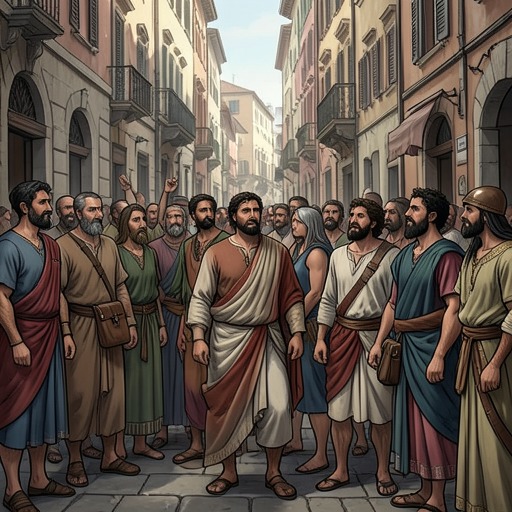
The army also forms part of the ordinary spectacle of Rome. In the crowded Forum, groups of soldiers and watchers advance in measured formation through the shifting crowds, preserving order in streets filled with traders, petitioners, visitors, and public speech. Their disciplined movement contrasts with the many-sided, heterogeneous city around them. The novel thus places soldiers within civic life as visible agents of order, though their presence does not make the city socially uniform or quiet.
Military power is also woven into imperial display beyond the city. When Nero travels to Antium, the crowds gather along the road, while detachments of mounted and foot guards control access and hold the line beside the route. The procession’s extensive equipment and attendants demonstrate the scale of resources that accompany the emperor. The scene associates armed protection with ceremony and spectacle as much as with combat.
The Great Fire and the Failure of Order
During the Great Fire, the Roman Army’s limits become conspicuous. As Vinicius approaches Rome, the Appian Way is congested with people fleeing the flames. Refugees occupy temples, fields, gardens, and cemeteries; fighting breaks out over shelter, and escaped enslaved people and other groups join the disorder. Praetorian soldiers protect some of the more peaceable population and engage the crowds in several places, but they cannot restore a functioning civic order amid the conflagration and mass displacement.
The fire’s spread intensifies the crisis. The narrative describes new outbreaks in places distant from the principal blaze and flames racing through densely built districts, where houses, shops, wooden structures, and storehouses supplied abundant fuel. People outside the city and gathered on aqueducts could see different materials burning by the colors of the flames. Rumors multiplied, including the accusation that Nero had ordered the city burned, while fear of robbery and revolt grew as people lost homes and ordinary bonds of authority broke down. These reports and suspicions belong to the atmosphere of the disaster; the evidence does not establish them as proven explanations for the fire.
After the Circus Maximus and whole streets have fallen, Tigellinus orders houses on the Esquiline demolished to create open space where the fire might die out. The measure is explicitly directed at saving what remains, not at rescuing the burning districts. Meanwhile, the destruction of the city’s stores leaves hundreds of thousands outside the walls in want. Hunger begins before adequate replacement supplies arrive, and crowds gather at Tigellinus’s temporary lodging demanding bread and shelter. Soldiers struggle to maintain order; in some places they meet armed resistance, while other crowds, with no weapons, challenge the authorities over their abandonment.
The first major delivery of bread shows how urgently supply and security have become linked. When provisions arrive at the Emporium, the crowd breaks through the gate and seizes them; loaves are trampled in the struggle, and flour spills across the ground. Soldiers take control of the building and disperse the crowd with arrows and missiles. The army can retake the depot, but the episode makes plain that coercive control cannot substitute for an orderly, sufficient system of relief.
Relief, Popular Politics, and the Army’s Limits
The response to the shortage combines practical provisioning with political reassurance. Petronius rides, unarmed except for his customary ivory cane, into the hostile crowd gathered amid the firelight. The people recognize him and quiet enough to hear his promises: the city will be rebuilt; gardens will be opened; wheat, wine, and olives will be distributed; and games and gifts will follow. The crowd’s response gathers around the demand for bread and circuses, and he calls on them to honor Nero and go to sleep before dawn. In this encounter, public order is recovered not by a military assault but through a mixture of relief promises, personal standing, and imperial spectacle.
Supplies subsequently arrive in greater abundance from Ostia and the surrounding region. Grain is sold at a low price and given freely to the indigent, alongside wine, olives, chestnuts, sheep, and cattle. People camp in imperial and aristocratic gardens, and hunger is averted. Yet robbery, murder, abduction, and nightly fighting continue; bodies are left on the banks of the Tiber, and sickness spreads through the camps. The distinction is important: renewed food supply addresses the immediate threat of famine, but it does not by itself restore public security. Across these episodes, the Roman Army remains an essential instrument of imperial power, while the novel shows that disaster can overwhelm its capacity to hold society together without effective relief and political trust.